 Khwaja Rasheed
Is AI Scaling Your Decisions Faster Than You Can Own Them?
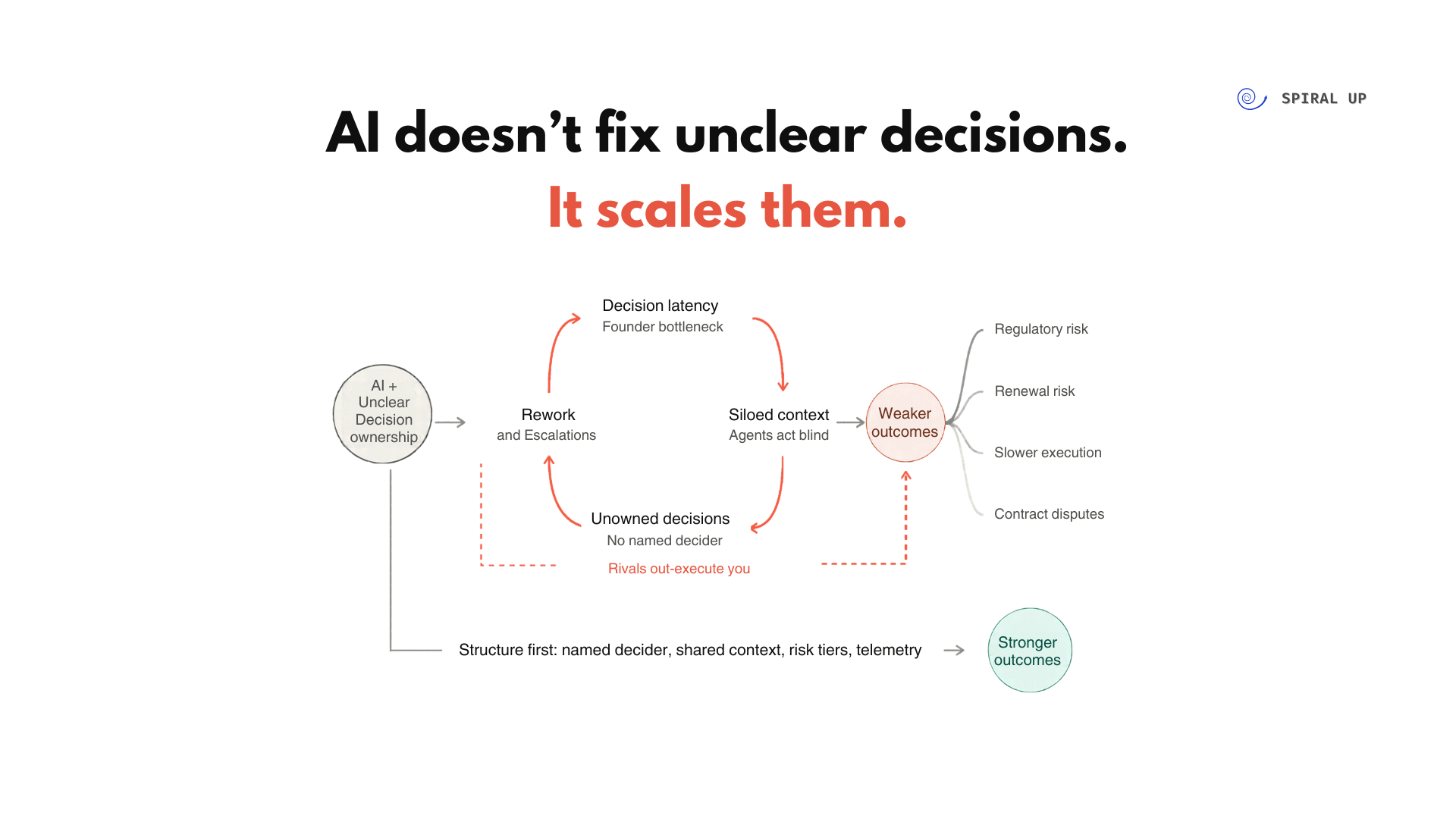
The founder bottleneck
In early stages, a founder is the operating system. Every decision routes to them: product, sales, engineering, and hiring. The shared context lives in the founder’s head.
As an organisation grows, newly hired mid-level managers often lack the authority to make calls on important matters. Some accept escalating everything rather than being overruled by the founder. The problem worsens in cross-functional teams, where different managers hold competing KPIs and look to pass blame to adjacent silos.
The cost is decision latency: the time between when a decision is needed and when it is made.
Anyone who has operated in a growth-stage company has encountered these symptoms:
- Simple pricing exceptions sit for days waiting for approval.
- The sales team promises roadmap commitments that put engineering teams at a crossroads.
- Customer escalations bounce between support, customer success, and product with no clear accountability.
- Strategy decks that read clearly become unrecognisable by week six of execution.
The fragile decision system
Once leadership fatigues and recognizes they are the bottleneck, they attempt to formalise the process. RACI, RAPID, and decision matrices get adopted, yet remain on paper for two primary reasons:
- Roles get assigned before goals. If nobody agrees on what the decision should achieve, people end up defending their box on the chart.
- The informal hierarchy wins. Real decisions happen over private messages, in ad hoc meetings, and in offhand calls from the founder.
As research on decision rights in Harvard Business Review demonstrates, a decision system works only when there is a single named decider for each class of repeated decisions. This decider knows they hold authority, and the organisation respects it in practice.
Volatility meets ambiguity
A new actor has entered the operating system: AI agents. Traditional software was deterministic; the same inputs produced the same outputs, and issues boiled down to finding and fixing bugs.
AI agents are probabilistic. Even system-one decision models choose different routes across runs and take direct action.
Whenever an agent drafts pricing, issues a quote, or resolves a customer ticket, it makes decisions on behalf of the company. Without a named accountable human, these decisions compound unchecked.
The jagged frontier
A study of 700+ consultants from a major firm by Harvard Business School researchers on navigating the jagged technological frontier introduced the concept of the jagged frontier. AI capability is not a smooth line; performance and accuracy depend strictly on whether a task sits inside or outside the model’s boundary.
For tasks inside the frontier, consultants produced results 25% faster with 40% higher quality. By contrast, when the same model was used on tasks outside its boundary, correct answers dropped by up to 24 percentage points.
This is compounded by the fact that many models are trained to produce persuasive prose rather than strictly verified conclusions.
The primary risk is not that AI is unreliable. It is that employees confidently adopt flawed outputs for tasks beyond the agent’s capability, especially when under time pressure.
The cost of fragmented context
Consider how enterprise software is adopted. Most companies deploy distinct platforms for each department. A human employee compensates for siloed data through conversation, memory, and manual cross-checking. An autonomous agent acts strictly on the data within its immediate view.
Imagine a marketing agent observes product engagement signals and triggers an automated upsell sequence, while a support agent simultaneously handles a critical production bug affecting that same account. Both agents act logically within their isolated scopes. The customer receives a sales pitch during an outage and concludes the vendor has lost operational control. A more advanced model will not resolve this unless the underlying context is shared.
B2B companies carry the highest exposure: an ill-timed message, inaccurate commitment, or inconsistent answer can trigger an executive escalation, renewal risk, or contractual dispute.
Regulatory headwinds
Under the EU AI Act enforcement framework, companies deploying AI into European operations face enforcement, with fines reaching up to €15 million or 3% of worldwide annual turnover starting in August 2026.
This reaches beyond foundation model vendors. Obligations and usage policies cascade down to companies deploying AI into customer-facing or high-risk workflows. Similar regulatory frameworks are advancing across major jurisdictions.
Enterprise procurement and security teams are moving ahead of regulations. Vendor questionnaires routinely demand explicit disclosures on AI data flows, decision overrides, and incident logging.
Governance at the core
Avoid chasing tools; begin with structure, followed by data, telemetry, and human-in-the-loop gates.
Establish a closed-loop operating system grounded in three principles:
- The human operating model (strategy to execution): For every class of decision, assign a single named decider with visible, practical authority. Establish an operating cadence to detect drift and reallocate resources as needed.
- The agentic operating model (governance as telemetry): Implement real-time audit logging, confidence thresholds, drift detection, and human-in-the-loop approvals. If an organisation lacks a named individual for recurring decisions, it is not ready for autonomous agents.
- Shared context across functions: Unify operational context across functional boundaries. Commitments made by one team or agent must immediately surface to adjacent functions.
Classify actions by risk
- Autonomous (AI only): Low-risk, fully reversible actions performed strictly within proven model boundaries.
- Supervised (Agent + Human): The agent drafts or recommends the action, and a named owner approves it.
- Human-only: Any decision carrying contractual, financial, regulatory, or relationship consequences beyond a defined threshold.
Structure first, speed second
The productivity gains of AI are demonstrable. However, they compound existing organisational defects in decision-making when governance is neglected. Companies that establish closed-loop systems, human steering, real-time telemetry, and shared context will secure the efficiency gains while protecting their enterprise value.