 Khwaja Rasheed
Before Product-Market Fit, Every New Market Is a Different Company
The situation
Consider a solo technical founder building real-time video analytics at the edge. The MVP works, a few demos have gone well, and an invitation arrives to join a quantum computing programme. Most of his leads either do not understand the solution or want him to build something outside his niche.
He is confident the existing application could work with quantum computing. So should he take the opportunity?
The answer depends on a question most founders skip: what, exactly, am I selling?
What “edge” and “real-time” actually commit you to
Two words in this product carry most of the weight: edge and real-time.
Detecting an intruder in a building is close to a static video problem. Counting shoppers in a store is a little harder. Applying the same idea to cars, trains, or aviation raises the requirements sharply, because camera, network, processor, and software pipeline all matter, along with latency, environmental conditions, failure modes, and the consequences of a wrong detection.
The underlying algorithm may be similar across all of these. The product needed to deploy it successfully will be very different.
Same founder, same demo, two businesses
Imagine one Monday:
In the morning, the founder demos to a retail chain that found him through a cold email. They want to count people and see which aisles are busy. A low-cost computer and a good camera will do, and a dropped frame costs almost nothing. The buyer wants a per-store price and will decide in a few weeks.
In the afternoon, a college friend who works in rail asks a sharp question. At 30 frames per second, a person walking at about 1.4 m/s moves roughly 5 cm between frames. A train at 160 km/h moves roughly 1.5 m between frames. That difference changes how detection must be designed, and it is only one part of the problem. Camera placement, exposure, resolution, and processing latency all affect performance, and in a safety-critical setting a missed detection has serious consequences.
The rail opportunity may be very valuable. But before deployment, the product may need to pass safety, procurement, IT security, and operational reviews, and the sales cycle could stretch across several quarters. A friend can open the door, but he cannot sign off on it.
The retail customer is buying operational analytics. The rail customer may be buying a system that has to satisfy demanding reliability and safety requirements. The difference is not just the hardware price. It is the entire path from prototype to production.
The adjacent-market tax
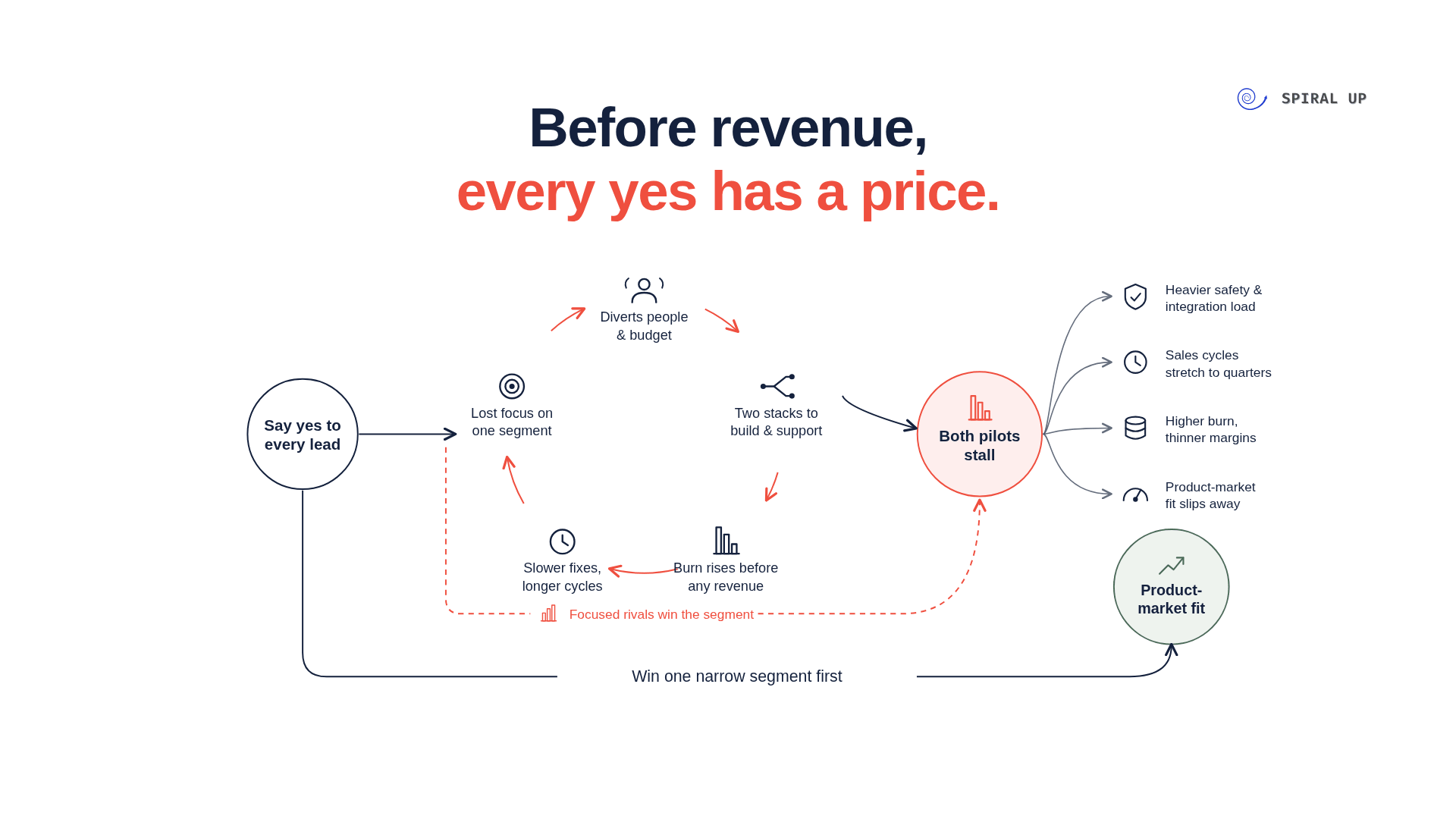
The adjacent-market tax is the cost a company pays every time it takes on a second market before the first one works. If both opportunities go well, the founder has two options, and both are expensive:
- Grow the team and budget. He raises money against two different problem spaces, hires embedded and safety engineers for one customer and integration people for the other, and finds salespeople who understand each buyer. Hiring and ramp-up take months, and burn rises before either customer has paid.
- Stretch the existing team. The same few people move between retail support calls and certification-grade testing in a single week. Retail fixes slow down. The rail customer sees a vendor that is not fully committed. When something goes wrong, nobody can tell which change caused it, and both pilots stall together. One may survive. Both surviving is unlikely.
If he chooses only one, each path ties him to its domain:
- Rail first means government procurement, tenders, safety cases, regulatory approvals, legacy onboard systems, and long operational validation. The upside may be large, but the route to revenue demands patience and specialist expertise, and the product, team, and commercial model all become tailored to that market.
- Retail first gives faster answers. He has to embed with retail operations, demonstrate measurable value, make deployment simple, and fit each chain’s cameras, store systems, and IT security review. Growth comes from more stores or more chains at similar price points, so the product is designed around cheap hardware and thin margins.
Moving from retail to rail later is possible, but it would require substantial new engineering, validation, assurance, and commercial relationships. Success in retail does not automatically earn credibility in rail.
Either way, the price is paid before the revenue is.
Why a narrow focus works
Geoffrey Moore’s Crossing the Chasm makes a related argument: win one narrow segment first and build a complete solution for it, rather than serving everyone partially. It is a point about how technology companies move from early adopters to the mainstream, but the beachhead logic applies just as well to a pre-PMF founder choosing a first market.
Focus matters more when the product is tightly coupled to hardware, because every new environment can reopen design decisions that seemed settled.
What the data says about why pilots stall
Research on enterprise AI points in the same direction:
- Deloitte’s 2026 enterprise AI report cites cost, safety regulations, and the need for specialist hardware as barriers to adopting physical AI.
- Deloitte’s research on AI experiments found that only about a quarter of companies had moved 40% of their AI experiments into production.
- In a Madrona survey of enterprise AI adoption on why pilots fail, the top reasons were integration with existing systems and security and compliance reviews. “It did not work as promised” ranked sixth.
In other words, the product itself was rarely the issue. Fitting it into the buyer’s world was.
The same trap at growth stage
The adjacent-market tax is not limited to solo founders. A growth-stage B2B company pays it whenever a large customer asks for a special feature, integration, or compliance arrangement, and the company says yes without asking whether other customers will want it.
Each custom deal adds roadmap items, support burden, and risk that only one customer benefits from. Over time the product starts to look like several products sharing a single name.
The tell is the same at any size: if every customer requires a different product, you do not yet have a repeatable business.
What about quantum?
The momentum is real. McKinsey’s 2026 Quantum Technology Monitor counts $12.6 billion invested in quantum start-ups in 2025. But the main use cases it highlights are chemicals, finance, pharma, and logistics. Real-time video analytics is not among them.
Even if the capability exists, the important question is narrower: does it give a measurable advantage on this specific problem, compared with the best classical methods already available? If not, the quantum programme is a distraction dressed up as an opportunity.
Before you commit to another direction
If prospects do not understand your solution, the cause may not be missing technology. It may be unclear positioning, an imprecise target market, or a conversation with the wrong buyer. Before committing to another development path, answer five questions:
- Who is the specific buyer? Not just the industry, but the person or team responsible for the problem and its budget.
- What painful problem are we solving? Can the buyer recognise it immediately and explain why it matters?
- What is the measurable value? Does it save money, reduce risk, improve operations, or create revenue?
- What stands between the demo and production? Consider integration, security, hardware constraints, validation, and procurement.
- Can we sell and deploy repeatedly? Or will every customer need a custom product?
If the answers are vague, refine positioning and customer discovery before adding another capability.
A dated prediction
Prediction (19 October 2026): Over the next two years, most stalled AI pilots will be traced to integration, security review, and unclear buyer ownership rather than model quality. Companies that choose one segment and a repeatable deployment path will reach production sooner than those that pursue several at once.
What would prove this wrong: Data showing that model performance, not integration or compliance, is the main reason for pilot failure, or that multi-segment early-stage companies reach production as often as focused ones.